

Spirit of the Wind for Kids III: A Native American Arts & Crafts Workshop

Spirit of the Wind Proudly Presents:
Spirit of the Wind for Kids III
A Native American Arts & Crafts Workshop
Date: Saturday, July 17, 2027
Time: From 10 AM to 2 PM
Location: Weed Community Center
161 E. Lincoln Ave, in Weed, CA 96094
Cost: ZERO
This event is completely free of charge for all participants!
This is Spirit of the Wind's third event, especially crafted for kids, conceived by our CEO, Daniel Pruett (Cloud Eagle), and produced by him and his wife, Fernanda Froes-Pruett, with help from our amazing team of volunteers, including Sary Dobhran.
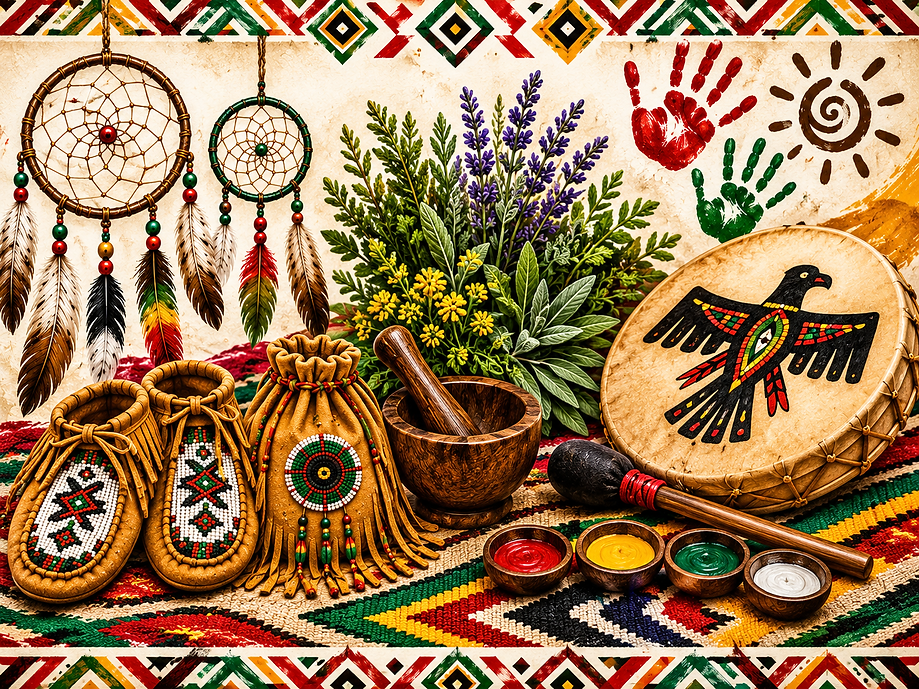
We are hosting 15 to 20 kids and their parents (a maximum of 50 people) at an Arts & Crafts station with moccasin kits, dream-catcher kits, and medicine bags.
The children aged 7 to 12 will receive a dream-catcher kit to create their own unique designs, allowing them to bring home something meaningful they made by hand.
Children aged 13 and older will receive a Native American moccasin kit to assemble and take home the shoes they made using their talent and creativity.
All participants, kids and parents, will be gifted a Native American Medicine Bag and have a demonstration on how Native American medicinal herbs are used.

In some Indigenous traditions, making moccasins is an act of care and responsibility. Knowledge may be passed between generations—learning how to prepare materials, make patterns, stitch, bead, and understand culturally meaningful designs.
Dreamcatchers are among the most recognizable Indigenous cultural objects today, but an important point is often lost: they are not originally a tradition shared by all Native American peoples. The dreamcatcher is most strongly associated with the Ojibwe (Anishinaabe) people of the Great Lakes region, although related traditions spread to other Indigenous communities over time.“
Moccasins reflect the diversity of Native peoples. Their materials, construction, decoration, and cultural significance vary from nation to nation and developed in relationship with each people’s homeland, environment, and traditions.”
We are hosting a drum circle featuring Native American storytelling and songs, a demonstration of how Native American Medicinal Herbs are used, special guests to be announced, and more!
We are also hosting Karrol Martin, an amazing face-painting artist from Eugene, OR, to create beautiful designs for the kids who choose to have their faces painted during the event, as well as for their parents.
And we're having pizza from the Pizza Factory in Weed, CA, for lunch, with water, iced tea, and soft drinks.
EVERYTHING IS FREE OF CHARGE FOR ALL PARTICIPANTS!
This event will be broadcast live on our social media.
Our focus is to bring Youth and Culture together through our Arts & Crafts activities and to keep the Native American Traditions alive!

• Native American Dream Catchers, Moccasins, and Medicine Bags.
• Demonstration of Native American medicinal herbs.
• Drum Circle
• Face-Painting
• Pizza and soft drinks.
• And lots of fun!
Moccasins in the Northern California region:
Historically, footwear in Northern California was influenced by the landscape and climate. People traveled through forests, river valleys, mountains, rocky areas, and—in the higher country—snow. Deerskin and other locally available animal hides were important materials for clothing and footwear.
Moccasins could be constructed from carefully prepared, softened hide. Their form tended to be practical and adapted to local conditions rather than resembling the heavily beaded Plains-style moccasins that many people now associate with the generic image of “Native American moccasins.”
This distinction matters because the highly recognizable beaded moccasins of Lakota, Cheyenne, Crow, and other Plains peoples belong to different artistic and cultural traditions.
Dreamcatchers:
The dreamcatcher originated within Ojibwe (Anishinaabe) tradition and later became widely used among other Native peoples. Its woven web is associated with protection, particularly during sleep, but its teachings and meanings can vary among communities and families.
The central meaning of the dreamcatcher is protection, especially protection during sleep. Its origins are most strongly associated with the Ojibwe (Anishinaabe) people, although dreamcatchers were later adopted and interpreted by other Native communities.
Protection and the web:
The woven web is often understood as a protective web, connected in Ojibwe teachings with Asibikaashi, the Spider Woman, a protective figure particularly associated with watching over children.
Dreamcatchers were traditionally placed near a sleeping area, especially near children.
A widely known teaching says that the web catches harmful dreams or negative influences, preventing them from reaching the sleeping person. With the arrival of daylight, those harmful dreams disappear. Good dreams can pass through and reach the sleeper.
Shasta People:
The Shasta people, whose ancestral homelands include areas around what is now the California–Oregon border and portions of the Klamath River system, traditionally used animal hides for clothing and footwear.
Deer were particularly important—not simply as a source of material but as part of a much larger relationship between people, animals, and the environment.
Hides could be transformed into useful clothing and footwear through skilled preparation and sewing.
Moccasins protected feet while still allowing considerable flexibility when traveling through the region.

Must
register
to
participate!
Please register by filling out this form with your name and email, and let us know who you'd like to bring.
We will be in touch with you about the details.
Thank you so much for participating!
Daniel Pruett (Cloud Eagle)
CEO/President
Spirit of the Wind
E-Mail: contact@spiritofthewind.org
Tel: 530 (859-2450)

